Guide
Boiled Egg Time Chart: How Long to Boil an Egg by Size
How long to boil an egg for a runny, jammy, or hard yolk. Exact times for small to extra large eggs, straight from the fridge or at room temperature.
Updated 3 min read

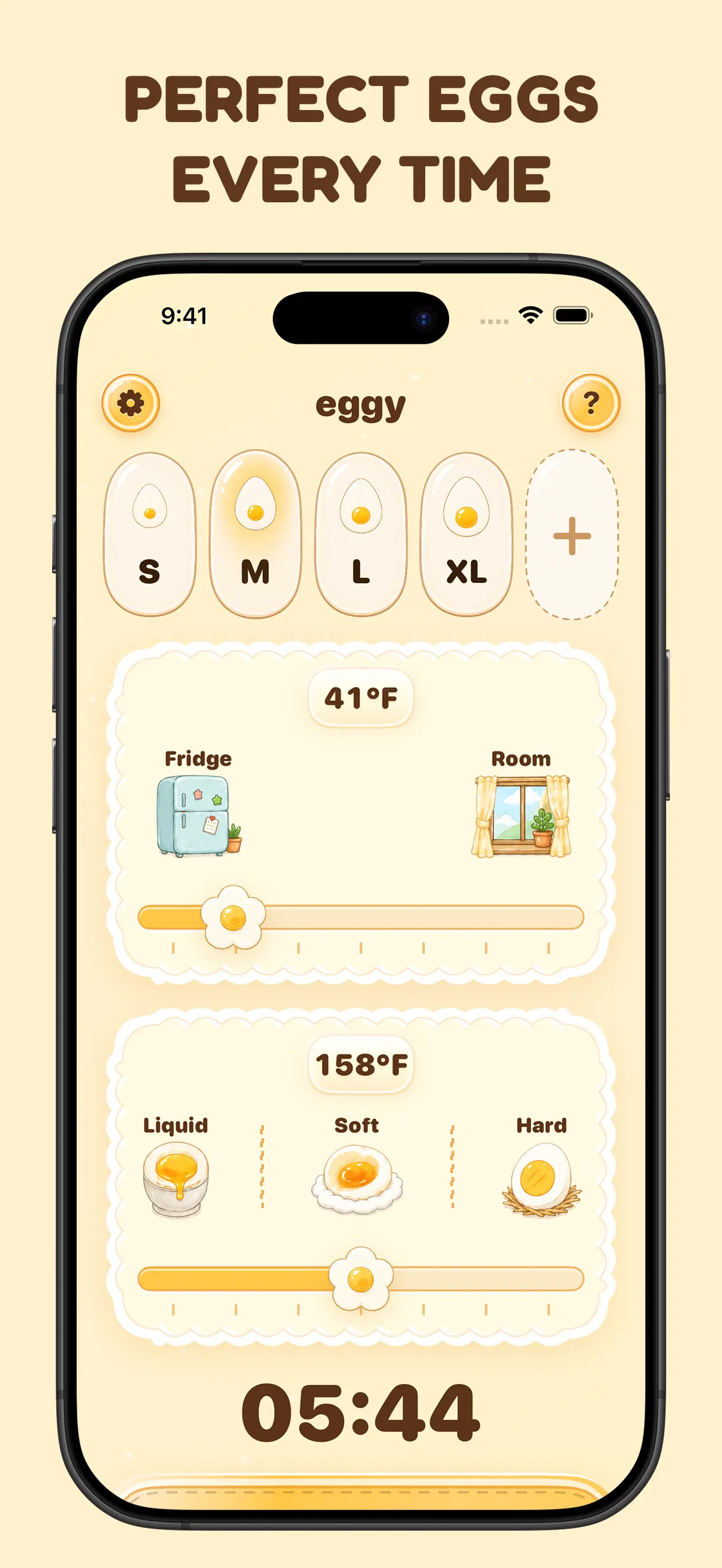
Want the boiling time for your exact egg? Egg Timer is free to download.

Short answer
A large egg (65 g) straight from the fridge needs about 4 min 50 s in boiling water for a runny yolk, 6 min 25 s for a jammy yolk, and 10 minutes for a hard yolk. Smaller or room-temperature eggs need less time, so find your egg's size and starting temperature in the chart below.
Most recipes give one boiling time and quietly assume a medium egg at room temperature. Use that time on a large egg straight from the fridge and the yolk comes out underdone. That’s why the same “6 minutes” gives you a perfect egg one day and a raw one the next.
Two things set the time: how big the egg is and how cold it is when it goes in. The charts below cover both.
Boiled egg time chart: eggs straight from the fridge
For eggs at fridge temperature, 5 °C (41 °F), lowered into water at a rolling boil.
| Egg size | Runny yolk | Jammy yolk | Hard yolk |
|---|---|---|---|
| Small (45 g) | 3 min 49 s | 5 min 1 s | 7 min 55 s |
| Medium (55 g) | 4 min 22 s | 5 min 44 s | 9 min 3 s |
| Large (65 g) | 4 min 52 s | 6 min 24 s | 10 min 7 s |
| Extra large (75 g) | 5 min 22 s | 7 min 3 s | 11 min 8 s |
Boiled egg time chart: eggs at room temperature
For eggs at room temperature, 20 °C (68 °F), lowered into water at a rolling boil.
| Egg size | Runny yolk | Jammy yolk | Hard yolk |
|---|---|---|---|
| Small (45 g) | 2 min 50 s | 4 min 2 s | 6 min 57 s |
| Medium (55 g) | 3 min 14 s | 4 min 36 s | 7 min 56 s |
| Large (65 g) | 3 min 37 s | 5 min 9 s | 8 min 52 s |
| Extra large (75 g) | 3 min 59 s | 5 min 40 s | 9 min 46 s |
A fridge-cold egg needs 1 to 1½ minutes more than the same egg at room temperature for a runny or jammy yolk.
Check your egg’s weight, not only the carton size
Carton sizes differ by country. A US large egg weighs about 57 g (2 oz), so it sits closer to the medium row above. A US extra large egg, about 64 g, is closest to the large row (USDA egg size standards).
If you have a kitchen scale, weigh one egg from the box. A few grams makes a difference you can see in the yolk.
Where these times come from
The times come from a physics formula for heating an egg, worked out by Dr Charles Williams at the University of Exeter (the egg equation). It calculates how long the yolk takes to reach a target temperature from the egg’s weight and starting temperature. The yolk targets used here are 63 °C for runny, 70 °C for jammy, and 82 °C for hard.
How to boil an egg with the right timing
- Bring the water to a rolling boil. Use enough water to cover the eggs.
- Lower the egg in gently with a spoon, straight from the fridge or the counter.
- Start the timer for your egg’s size, starting temperature, and yolk.
- Move the egg to ice water the moment the time is up. The egg keeps cooking from its own heat, so cooling it right away keeps the yolk the way you timed it.
- Peel and eat. Cracking the shell all over under cold water makes peeling easier.
When your egg doesn’t match a row
Real eggs rarely match a chart exactly. One weighs 58 g, another sat on the counter for ten minutes, and some mornings you want the yolk a little softer than usual.
That’s the reason we made Egg Timer. You pick the carton size or type in the exact weight, set how cold the egg is, and choose the yolk you want. It works out the time with the same formula as the chart above, then counts down on your Lock Screen or Apple Watch and tells you when to move the egg to cold water.