Guide
Badminton Scoring Rules Explained, Including the New 15-Point System
How badminton scoring works in singles and doubles, who serves from which court, and what changes when the 15-point system replaces 21 points in January 2027.
Updated 3 min read

Tired of arguing about the score mid-rally? Badminton Scoreboard is free to download.

Short answer
Badminton uses rally scoring: every rally wins a point, whoever served. A game goes to 21 points, you must win by 2, and 30 points wins outright at 29-all. A match is best of three games. From January 4, 2027, BWF switches to 15-point games, still won by 2 and capped at 21.
Badminton scoring is simple until it isn’t. Counting to 21 is easy. Remembering whether it’s 14-12 or 12-14, and who should be serving from which court in doubles, is where most games stop for an argument.
This guide covers the official rules from the BWF Laws of Badminton, the new 15-point system that starts in January 2027, and the serving rules most players get wrong.
How badminton scoring works
- Rally scoring. Every rally wins a point, whichever side served. The rally winner serves next.
- Games to 21. The first side to 21 points wins the game.
- Win by 2. At 20-all, a side needs a two-point lead, such as 22-20.
- Cap at 30. At 29-all, the next point wins the game 30-29.
- Best of three. The first side to win two games wins the match.
- Intervals. Players get up to 60 seconds when the leading score reaches 11, and up to 2 minutes between games.
- Changing ends. Players switch ends after each game, and in the third game when the leader reaches 11.
- Serving the next game. The winner of a game serves first in the next one.
The new 15-point system from 2027
BWF members voted on April 25, 2026 to replace 21-point games with a 3x15 format. It takes effect on January 4, 2027 (BWF). Here is what changes:
| Rule | 21-point system | 15-point system (from 2027) |
|---|---|---|
| Points to win a game | 21 | 15 |
| Win by 2 starts at | 20-all | 14-all |
| Cap | 30 (at 29-all) | 21 (at 20-all) |
| Mid-game interval | Leader reaches 11 | Leader reaches 8 |
| Change ends in the third game | Leader reaches 11 | Leader reaches 8 |
| Games per match | Best of 3 | Best of 3 |
| Interval between games | 2 minutes | 2 minutes |
Rally scoring and the serving rules stay the same.
Who serves, and from where: singles
The server’s score decides the service court:
- Even score (0, 2, 4…): serve from the right service court.
- Odd score (1, 3, 5…): serve from the left service court.
The receiver stands in the diagonally opposite court. If the receiver wins the rally, they score a point and serve next, from the court that matches their new score.
Who serves, and from where: doubles
Doubles is where most scoring arguments start. Three rules settle it:
- The serving side’s score sets the court. Even score, serve from the right. Odd score, serve from the left.
- When the serving side wins a rally, the same player serves again, and the two partners swap service courts.
- When the receiving side wins a rally, they gain the serve, and no one moves. The new server is whichever partner is already standing in the court that matches their side’s score.
A quick example with Anna and Ben against Clara and Dan:
- 0-0. Anna serves from the right.
- Anna and Ben win the rally: 1-0. Anna serves again. She and Ben swap, so she now serves from the left.
- Clara and Dan win the rally: 1-1. They gain the serve. Their score is odd, so the server is whichever of them is standing in the left court. Nobody switches.
- Clara and Dan win again: 1-2. The same server continues, the partners swap, and the serve now comes from the right.
How to keep score without arguing
- Call the score before every serve, the server’s score first: “14-12” means the server has 14.
- Agree on the format before you start: 21 or 15 points, and best of one or three games.
- Settle a disputed rally first, then correct the score from the last one everyone agrees on.
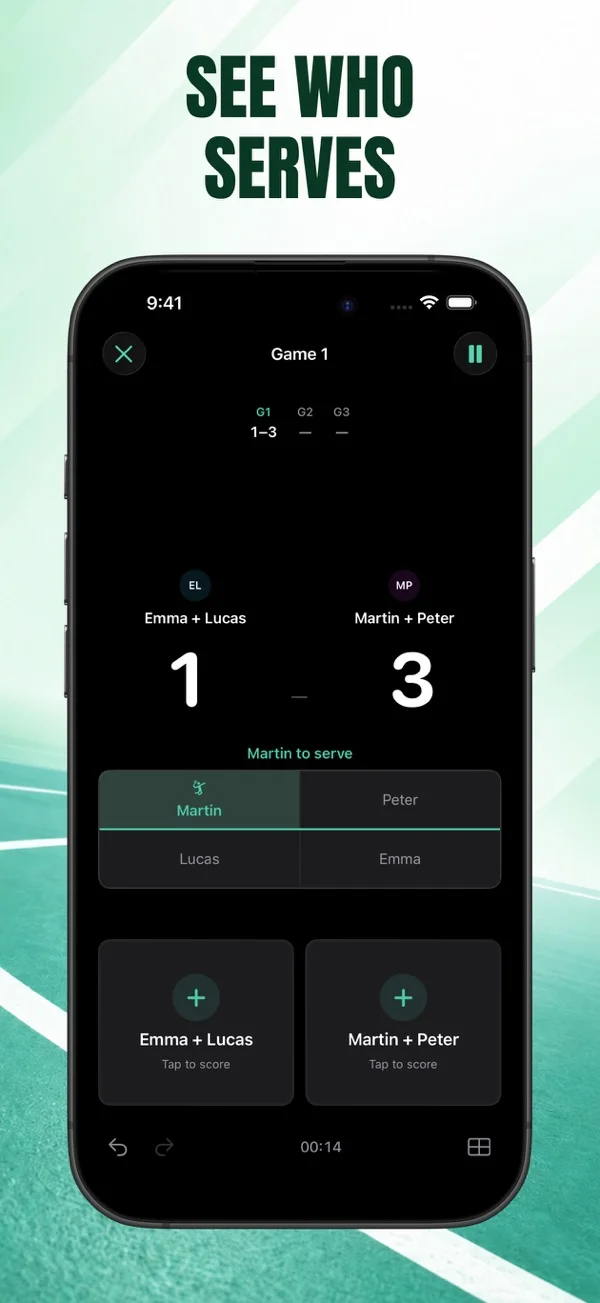
If you’d rather not keep it all in your head, a scoring app helps. We make Badminton Scoreboard for exactly this: you tap the side that won each rally, and it keeps the score and shows who serves next, from which court. In doubles it draws the court with both pairs, which settles the rotation question above without anyone stopping to think. It supports both the 21-point and the new 15-point format, and you can score from Apple Watch instead of holding your phone.